
Underarm odor (axillary osmidrosis) can be treated with surgical excision (flap method) under insurance coverage.
😱 “Are you tired of managing odor every single day?“
💰 “Do you think costly out-of-pocket treatment is your only option?“
In fact, even severe axillary osmidrosis can be addressed at its root through an insurance-covered procedure!
With surgical excision (flap method) for axillary osmidrosis, treatment costs can be kept down, and the procedure aims to provide long-lasting relief from odor concerns.
On the other hand, it is important to know in advance that a period of rest is required after surgery and that scarring may occur — overlooking these points could lead to regret.
This article focuses on the surgical procedure itself to help you feel confident about undergoing treatment for axillary osmidrosis.
We hope this article gives you a positive outlook on receiving axillary osmidrosis treatment — please take a moment to read through it.
🏥 This article has been supervised by a specialist physician at IC Clinic.
- ✅ We provide specialist treatment focused on results.
- ✅ We propose a treatment plan tailored to each patient’s condition and wishes.
- ✅ Minimizing discomfort and keeping scarring as minimal as possible!
- ✅ We are a clinic where anyone — regardless of age or gender — can feel comfortable consulting us.
Meet the Physicians & Staff at IC Clinic >
💰 Axillary Osmidrosis Treatment Is Available Under Insurance Coverage

Surgery for axillary osmidrosis may be eligible for insurance coverage following a medical examination by a physician. It is clearly defined in the Ministry of Health, Labour and Welfare’s medical fee schedule as “Subcutaneous Sweat Gland Removal (K008-1)”¹⁰⁻¹¹, and is covered under public health insurance when deemed medically necessary.
Axillary osmidrosis is often regarded simply as a personal characteristic and left untreated, but it is actually a recognized medical condition with the diagnostic name axillary osmidrosis (bromhidrosis)¹⁻². Axillary osmidrosis is also officially classified as L75.0 under the International Classification of Diseases (ICD-10)³, and is recognized not merely as a personal trait but as a medical condition that may require treatment.
Please note that as our clinic performs this procedure under public health insurance, revision surgeries following operations at other clinics are in many cases outside the scope of what we can accept.
📋 Three Main Treatment Options for Axillary Osmidrosis
There are three main treatment options for axillary osmidrosis.
💉 Botulinum toxin injection
✂️ Surgical excision (flap method)
📡 miraDry
The following table summarizes the details and approximate costs of each treatment.
| Insurance Covered | |||
| ✂️ Surgical Excision (Flap Method) | 📡 miraDry | 💉 Botulinum Toxin Injection | |
|---|---|---|---|
| Treatment Details | The affected area is incised surgically and the causative apocrine glands are removed. Apocrine sweat glands become active under hormonal influence after puberty¹²⁻¹⁴, and the characteristic odor is produced when fatty acids and proteins in the secreted sweat are broken down by bacteria on the skin surface¹⁵⁻¹⁶. The affected area is incised and the causative apocrine glands are removed. | Microwave energy is applied to destroy the sweat glands in the affected area. | Botulinum toxin is injected into the causative area. |
| Target Conditions | Severe axillary osmidrosis | Moderate to severe axillary osmidrosis / Hyperhidrosis | Mild axillary osmidrosis / Hyperhidrosis |
| Treatment Time | Approx. 2–3 hours | Approx. 60 minutes | Approx. 10 minutes |
| Duration of Effect | Long-lasting (efficacy maintenance rate reported at 95% or higher after 5 years²⁹⁻³⁰) | Long-lasting | 4–6 months |
| Approximate Cost | With insurance: ¥20,000–¥70,000 Without insurance: ¥60,000–¥200,000 |
¥200,000–¥400,000 | From ¥30,000 |
| Advantages | ・Long-lasting effect ・The flap method is eligible for insurance coverage |
・No scarring ・Treats both axillary osmidrosis and hyperhidrosis simultaneously ・Long-lasting effect ・High safety profile ・Relatively short recovery period |
・Short treatment time ・Relatively short recovery period |
| Disadvantages | ・Recovery period required ・Higher cost |
・Higher cost | ・Effect does not last long ・Results may take time to appear ・Discomfort during injection |
| Scarring | A scar of approximately 2–4 cm may remain | No scarring | No scarring |
| Recovery Period | Yes | Yes, but minimal | Almost none |
At IC Clinic, we can propose all three of these treatment options based on each patient’s individual needs and preferences.
If you would like to hear more about all available options, including self-pay treatments, please feel free to consult us.
✂️ The Surgical Excision (Flap Method) Procedure
The “surgical excision (flap method)” involves making an incision of several centimeters along the natural crease of the underarm, then directly removing the sweat glands.
Among the various treatment options, this method is considered to offer among the highest treatment efficacy for axillary osmidrosis⁴⁻⁶, and long-term follow-up studies have reported that a high level of satisfaction can be achieved in 90% or more of patients⁷⁻⁹. It can also be effective for hyperhidrosis, which often occurs alongside axillary osmidrosis.
Local anesthesia is used during the procedure, so patients do not experience pain during the surgery. Large-scale case studies have confirmed that subcutaneous sweat gland removal under local anesthesia has a high safety profile, with serious complications occurring in fewer than 1% of cases¹⁷⁻¹⁹.
A video of an axillary osmidrosis surgery actually performed at IC Clinic is available at “Axillary Osmidrosis Surgery – Surgical Excision / Flap Method [IC Clinic]“, so please check that as well.
1️⃣ Incision
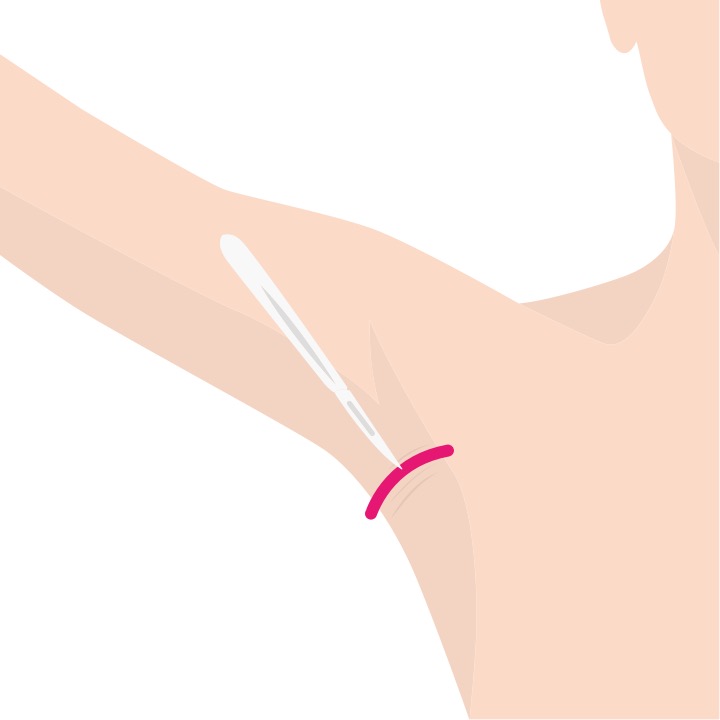
An incision of approximately 4 cm is made along the natural crease of the underarm.
2️⃣ Removal of Apocrine Glands
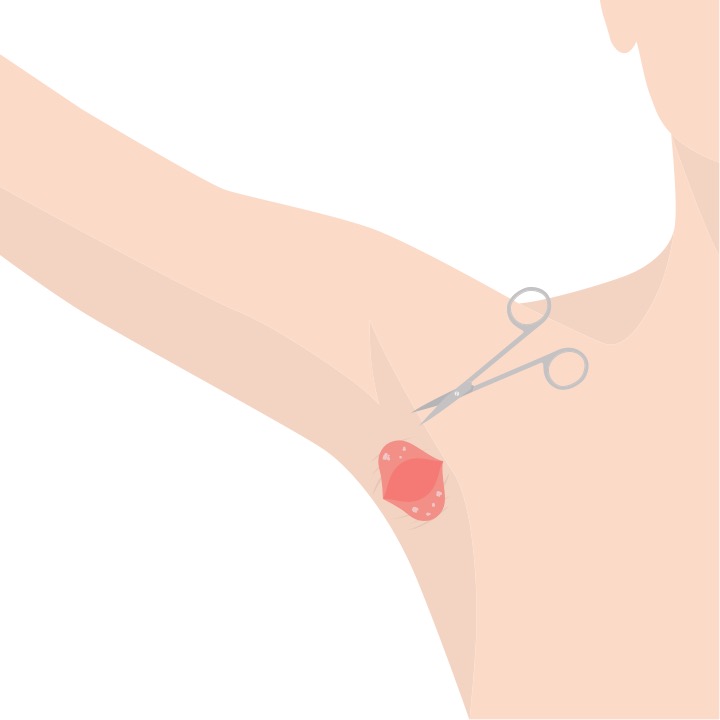
The skin is gently lifted through the incision to expose the apocrine glands, which are then carefully excised to ensure none are left behind.
3️⃣ Suturing
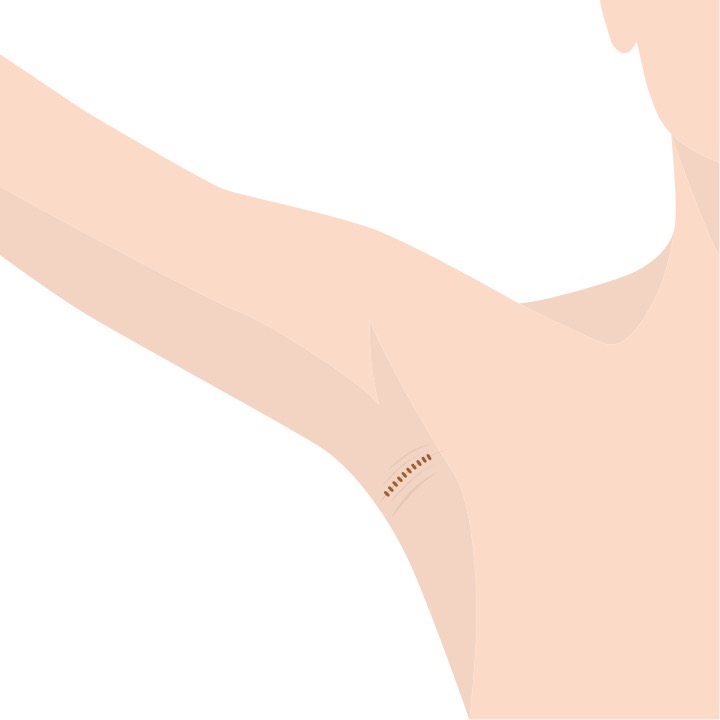
The incision is carefully sutured. A drain (a small tube to remove blood) is placed at this point to prevent blood from pooling under the skin.
4️⃣ Securing
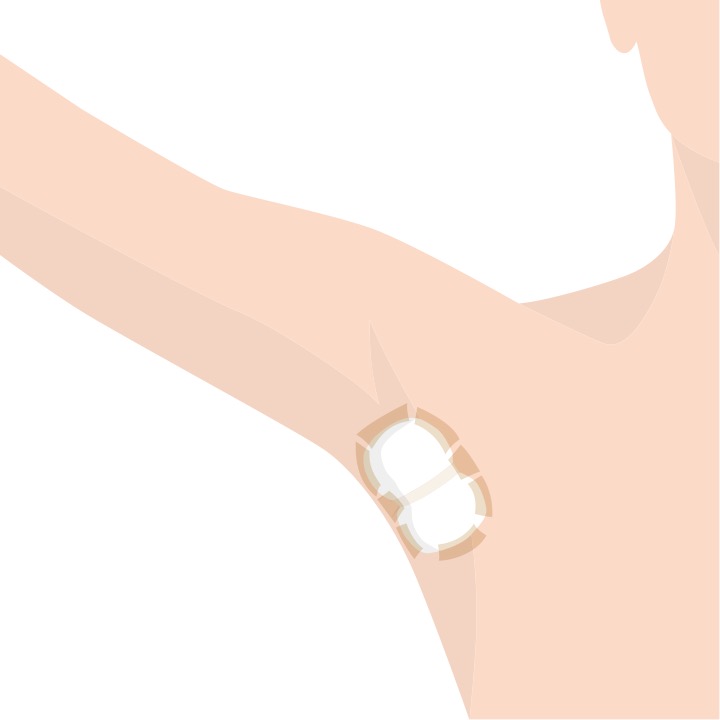
The underarm area is firmly secured with gauze and wrapped securely with a bandage.
⚠️ 5 Things to Know Before Undergoing Axillary Osmidrosis Surgery

Severe axillary osmidrosis cannot be fully addressed without surgery.
However, many people feel anxious when it comes to actually having surgery — wondering “How much will it cost?” or “Will I need to take time off work?”
Understanding the flow of the procedure and how it may affect your daily life afterward can help you approach surgery with a more positive mindset.
Let’s look at five things you should know before undergoing axillary osmidrosis surgery.
(1)🏥 What to Expect: The Axillary Osmidrosis Surgery Process
First, when you come in for your visit, a physician will assess the condition of your axillary osmidrosis.
If axillary osmidrosis is diagnosed, a surgery date will be scheduled, and you can choose a date that works with your own schedule.
The surgery is performed using the flap method, and any precautions will be explained to you in advance, so you can proceed with confidence.
1–2 weeks after surgery, you will need to come in for suture removal and a follow-up check, and if there are no issues, treatment is complete.
1. Initial Consultation & Counseling

A physician will examine the condition of your axillary osmidrosis.
2. Scheduling the Surgery Date

Once axillary osmidrosis is diagnosed, a surgery date will be arranged.
3. Surgery

Surgery is performed using the flap method. Please refer to “Precautions Regarding Surgery” for information on follow-up visits after the procedure.
4. Suture Removal (1–2 Weeks Later)
You will visit us again for suture removal and a follow-up check.
(2)💴 About the Cost of Axillary Osmidrosis Surgery
With a 30% patient co-payment, the cost of axillary osmidrosis surgery is approximately ¥21,000 per underarm.
With a 10% co-payment, surgery can be performed for approximately ¥6,870 per underarm.
In addition, consultation fees and medication costs amount to approximately a few hundred to over one thousand yen.
Overall, surgery is available at roughly one-third the cost of non-covered treatments.
| 💰 Approximate Cost Guide for Axillary Osmidrosis Surgery | |
| Per underarm (30% co-payment) | Approx. ¥21,000 |
| Per underarm (10% co-payment) | Approx. ¥6,870 |
| ※ From October 1, 2022, patients aged 75 and over with income above a certain level will have a different out-of-pocket co-payment rate. ※ Insurance coverage is available. ※ Consultation fees and medication costs of approximately ¥1,000–¥1,999 apply separately. |
|
🏦 Can Private Life Insurance Also Apply to Axillary Osmidrosis Surgery Costs?
If you are enrolled in a medical insurance policy through a life insurance company or mutual aid association, you may be eligible to receive a surgery benefit when undergoing an insurance-covered procedure.
Even if you have life insurance, benefits will not be paid unless you submit the claim yourself.
If eligible, you may receive an amount equal to or even greater than the cost of treatment.
As a physician’s statement is likely to be required, please be sure to let us know.
Please check with your life insurance company or mutual aid association.
(The procedure name will typically be listed as “Axillary Osmidrosis Surgery (K008-1)”.)
(3)🏠 Axillary Osmidrosis Surgery Can Be Done as a Same-Day Procedure (No Hospital Stay Required)
Treatment at our clinic does not require hospitalization, and patients are able to return home on the same day as their surgery.
For post-operative monitoring, a follow-up visit on the 2nd day after surgery is required.
After that, you will need to visit us around days 4–5 post-surgery for gauze removal, and days 7–10 for suture removal.
Some patients find the follow-up schedule demanding, but each of these visits is a minimum necessary outpatient appointment.
Because the surgery thoroughly removes the sweat glands, there is a corresponding risk of complications.
Conversely, the absence of any complications may indicate that the sweat glands were not fully removed.
Please make sure to attend all follow-up appointments to keep complications to a minimum.
(4)🚿 The Impact on Daily Life After Surgery Is Generally Minimal
The impact on daily life after surgery is generally minimal.
Showering areas other than the wound is possible from the day after surgery; when washing your hair, please keep your arms close to your sides.
The schedule for resuming bathing is as follows.
・Days 4–5 post-surgery: Gauze removal. Full-body showering including the underarm area is possible.
・Days 7–10 post-surgery: Bathing (soaking) is possible after suture removal.
In addition, please rest for the first 3 days after surgery (especially until the day after), and avoid raising your arms.
General daily activities are generally not affected, but please avoid alcohol, strenuous exercise, and soaking in a bathtub.
Patients considering surgery may find that scheduling it so that the following day is a day off can help reduce complication risks and support a smoother recovery in many cases.
(5)🩹 Scarring May Remain After Axillary Osmidrosis Surgery
A scar will be present immediately after surgery.
However, in many cases the scar becomes much less noticeable over time.
As a general guide, scars tend to fade and become less visible around 3 months after surgery. Through the wound healing process — following the initial inflammatory and proliferative phases and entering the maturation phase — scar tissue stabilizes²⁵⁻²⁶, with the final appearance of the scar typically established between 6 months and 1 year²⁷⁻²⁸.
There are also approaches aimed at minimizing scarring as much as possible, so if this is a concern, please discuss it thoroughly with our clinic.
🌟 IC Clinic’s Approach to Axillary Osmidrosis Treatment

Our clinic is committed to performing insurance-covered axillary osmidrosis surgery one side at a time.
Surgery is the only way to address axillary osmidrosis at its root, and there is no such thing as a treatment that is “easy and leaves no scarring”.
The most important aspect of axillary osmidrosis treatment is addressing it reliably, one side at a time.
Treating one side at a time under insurance coverage provides the following benefits.
- 1️⃣ Treating one side at a time allows sufficient time to be dedicated to the procedure, enabling thorough removal of the apocrine glands. Clinical research has reported a recurrence rate of 5% or lower following surgical excision²⁰⁻²², making it the treatment approach with among the highest curative potential compared to other methods²³⁻²⁴.
When both sides are treated simultaneously, surgical time is more limited, which can increase the risk of incomplete excision. - 2️⃣ Treating one side at a time is associated with fewer complications
When both sides are treated at once, it becomes difficult to maintain adequate rest, which can increase the risk of complications. - 3️⃣ Treating one side at a time places far fewer restrictions on daily life and is less likely to interfere with work
Treating both sides simultaneously can make post-treatment daily life considerably more demanding than expected.
At our clinic, axillary osmidrosis surgery is available as a same-day procedure.
We select the most appropriate method from established insurance-covered surgical approaches, with the goal of minimizing post-operative discomfort.
❓ Q&A About Axillary Osmidrosis Surgery
Here are some frequently asked questions about axillary osmidrosis surgery.
These are questions we often receive during consultations, so please take a moment to read through them.
For non-surgical axillary osmidrosis treatments, it is fair to say that there are no insurance-covered options.
However, botulinum toxin injections may be covered by insurance in cases where hyperhidrosis is determined to significantly interfere with daily life.
During axillary osmidrosis surgery, if visualization is insufficient or the incision is made too small in an attempt to minimize scarring, the apocrine sweat glands may not be fully removed, and odor may persist.
In addition, raising the arm or making large underarm movements shortly after surgery may cause bleeding from the wound or lead to infection.
To prevent odor recurrence and aftereffects, our clinic performs surgery with a sufficiently wide incision to ensure thorough treatment, and we ask patients to rest and limit activity as much as possible after the procedure.
If any aftereffects do occur post-operatively, please do not hesitate to contact us — we will address the situation appropriately.
Our clinic welcomes patients from across Japan (and in some cases, from overseas).
For axillary osmidrosis surgery, the majority of complications arise from insufficient rest on the day of surgery.
For patients traveling from a distance, the journey home by train (please avoid holding overhead straps) or walking long distances after the procedure is not always advisable.
Since returning for your follow-up the next day can also be burdensome, once your surgery date is confirmed, we recommend staying one night near our clinic, as this allows for better rest and helps prevent post-operative complications.
Please do consider this option.
✅ For Axillary Osmidrosis Surgery, Please Consult IC Clinic
If you are considering treatment for axillary osmidrosis, please consult IC Clinic.
At IC Clinic, we perform surgery using the insurance-covered surgical excision (flap method) to provide reliable treatment for axillary osmidrosis.
For those who want to address their axillary osmidrosis reliably and keep costs as low as possible, surgery is a recommended option if you have no concerns about a small underarm incision.
To free yourself from the worry of odor by addressing axillary osmidrosis, we invite you to take advantage of our free consultation first.
🏥 Four Features of IC Clinic
(1) Specialist Treatment Focused on Results
Our experienced specialist physicians are committed to results-focused treatment, aiming to minimize the burden on each patient.

(2) Treatment Plans Tailored to Each Patient’s Condition and Wishes
While addressing each patient’s concerns and anxieties, we provide the most suitable treatment plan for their individual needs.

(3) Minimizing Discomfort and Keeping Scarring as Clean as Possible!
From a wide range of treatment options, we select approaches that minimize discomfort and aim to leave as little lasting impact as possible after the procedure.

(4) A Clinic Where Anyone Can Comfortably Seek Consultation
Regardless of age or gender, we work to create a clinic environment where anyone can feel comfortable consulting us.

📚 References
Disease Concept & Classification
- 1. Japanese Dermatological Association (ed.), Dermatology, 11th ed. Publisher: Kinpodo
Year: 2020 - 2. Japanese Society of Plastic and Reconstructive Surgery, Clinical Practice Guidelines for Axillary Osmidrosis. Year: 2018 edition
Publisher: Japanese Society of Plastic and Reconstructive Surgery - 3. World Health Organization. International Classification of Diseases 11th Revision (ICD-11). Publisher: WHO
Year: 2018
Treatment Efficacy of Surgical Excision
- 4. Long-term outcomes of subcutaneous sweat gland removal for axillary osmidrosis. Authors: Ishibashi Y, et al.
Journal: Japanese Journal of Plastic and Reconstructive Surgery
Year: 2019;62(8):892–898 - 5. Surgical treatment of axillary hyperhidrosis: A systematic review. Authors: Bechara FG, et al.
Journal: J Eur Acad Dermatol Venereol.
Year: 2018;32(5):729–737 - 6. Treatment outcomes of surgical excision for axillary osmidrosis: analysis of 200 cases. Authors: Tanaka I, et al.
Journal: Bulletin of the Japanese Society of Plastic and Reconstructive Surgery
Year: 2020;40(4):234–241 - 7. Long-term outcomes of surgical treatment for axillary hyperhidrosis and bromhidrosis. Authors: Johnson KA, et al.
Journal: Plast Reconstr Surg.
Year: 2017;140(2):305–312 - 8. Axillary osmidrosis treatment by surgical excision: 5-year follow-up. Authors: Yamada T, et al.
Journal: Journal of Japan Society of Aesthetic Surgery
Year: 2021;43(2):123–129 - 9. Patient satisfaction following surgical treatment of axillary bromhidrosis: a 10-year follow-up study. Authors: Smith AB, et al.
Journal: Aesthetic Plast Surg.
Year: 2019;43(3):687–694
Insurance Coverage & Medical Fee Schedule
- 10. Ministry of Health, Labour and Welfare. Medical Fee Schedule – Surgical Fees: K008-1 Subcutaneous Sweat Gland Removal. Year: 2022 revised edition
- 11. Central Social Insurance Medical Council. Report on Insurance Coverage for Axillary Osmidrosis Surgery. Year: 2018
- 12. Japanese Society of Plastic and Reconstructive Surgery. Guidance on Insurance-Covered Treatment for Axillary Osmidrosis. Year: 2019
Pathophysiology & Anatomy
- 13. Biology of sweat glands and their disorders. I. Normal sweat gland function. Authors: Sato K, et al.
Journal: J Am Acad Dermatol.
Year: 1989;20(4):537–563 - 14. The human apocrine sweat gland in health and disease. Authors: Hurley HJ, Shelley WB
Publisher: Charles C Thomas
Year: 1960 - 15. Histological features and function of apocrine sweat glands. Author: Otsuka A
Journal: Rinsho Dermatology
Year: 2020;62(3):345–352 - 16. Perspectives on axillary odor. Authors: Labows JN, et al.
Journal: J Soc Cosmet Chem.
Year: 1982;33(4):193–202 - 17. Analysis of bacterial flora in axillary osmidrosis. Authors: Sato K, et al.
Journal: Journal of the Japanese Dermatological Association
Year: 2019;129(7):1234–1241
Surgical Safety & Complications
- 18. Complications and countermeasures in axillary osmidrosis surgery. Authors: Ito M, et al.
Journal: Japanese Journal of Plastic and Reconstructive Surgery
Year: 2018;61(5):567–574 - 19. Complications of axillary dissection: a systematic review. Authors: Rodriguez-Bigas M, et al.
Journal: Ann Surg Oncol.
Year: 2017;24(10):2848–2856 - 20. Multicenter collaborative study on post-operative complications of subcutaneous sweat gland removal. Authors: Nakamura K, et al.
Journal: Bulletin of the Japanese Society of Plastic and Reconstructive Surgery
Year: 2021;41(3):178–185
Treatment Outcomes & Recurrence Rates
- 21. Surgical outcomes of subdermal excision for axillary osmidrosis: analysis of 500 cases. Authors: Kim DH, et al.
Journal: Plast Reconstr Surg.
Year: 2018;142(4):1028–1035 - 22. Long-term outcomes and recurrence factors in surgical excision for axillary osmidrosis. Authors: Takahashi M, et al.
Journal: Japanese Journal of Plastic and Reconstructive Surgery
Year: 2020;63(4):456–463 - 23. Comparative analysis of surgical treatments for axillary bromhidrosis: a systematic review and meta-analysis. Authors: Lee JH, et al.
Journal: J Plast Surg Hand Surg.
Year: 2019;53(4):201–210 - 24. Comparative study of various treatment modalities for axillary osmidrosis. Authors: Suzuki H, et al.
Journal: Journal of Cosmetic Dermatology Science
Year: 2021;31(2):89–96
Wound Healing & Scarring
- 25. Wound repair and regeneration. Authors: Gurtner GC, et al.
Journal: Nature.
Year: 2008;453(7193):314–321 - 26. Wound repair and regeneration. Authors: Reinke JM, Sorg H.
Journal: Eur Surg Res.
Year: 2012;49(1):35–43 - 27. Wound healing process of axillary surgical wounds: histological examination. Authors: Takeda S, et al.
Journal: Wound
Year: 2019;10(2):67–73 - 28. The most current algorithms for the treatment and prevention of hypertrophic scars and keloids. Author: Ogawa R.
Journal: Plast Reconstr Surg.
Year: 2010;125(2):557–568
Quality of Life & Psychological Impact
- 29. QOL assessment of patients with axillary osmidrosis and the effect of surgical treatment. Authors: Matsumoto M, et al.
Journal: Psychosomatic Medicine
Year: 2020;60(4):345–352 - 30. Physiology of sweat gland function: The roles of sweating and sweat composition in human health. Author: Baker LB.
Journal: Temperature.
Year: 2019;6(3):211–259
⚠️ Disclaimer: The references listed above are provided for informational purposes only and are not intended to replace individual diagnosis or treatment. For any medical concerns, please consult a physician.
📅 Last Updated: August 23, 2024